Monthly webinars starting soon .......

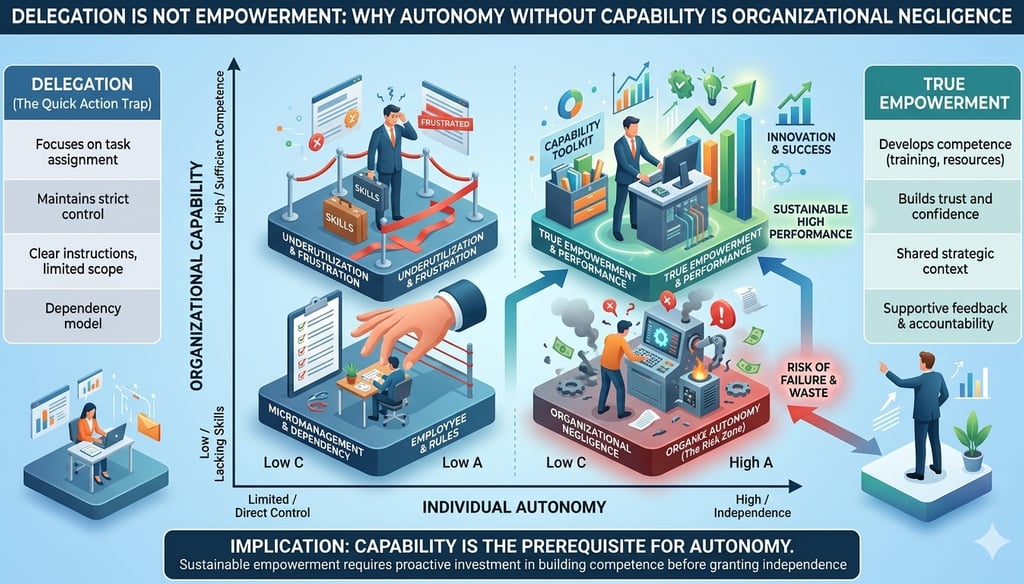
Delegation Is Not Empowerment: Why Autonomy Without Capability Is Organizational Negligence
Delegation is often mistaken for empowerment—but true empowerment goes far deeper. This thought leadership article explores why simply handing over decisions is not enough, and how organizations must build systemic capabilities like systems thinking, strategic decision-making, and psychological safety to enable true autonomy. Discover practical frameworks, tools, and leadership shifts required to create self-governing teams that can navigate complexity, make high-quality decisions, and drive enterprise agility. A must-read for leaders looking to move beyond delegation and build scalable empowerment across their organization.
LEADERSHIP AGILITY
Nivarti Jayaram
3/31/20263 min read
There’s a quiet but dangerous myth that has taken root in modern organizations:
If you delegate decisions, you’ve empowered people.
It sounds progressive. It feels modern. It even looks like leadership maturity.
But it’s incomplete—and often irresponsible.
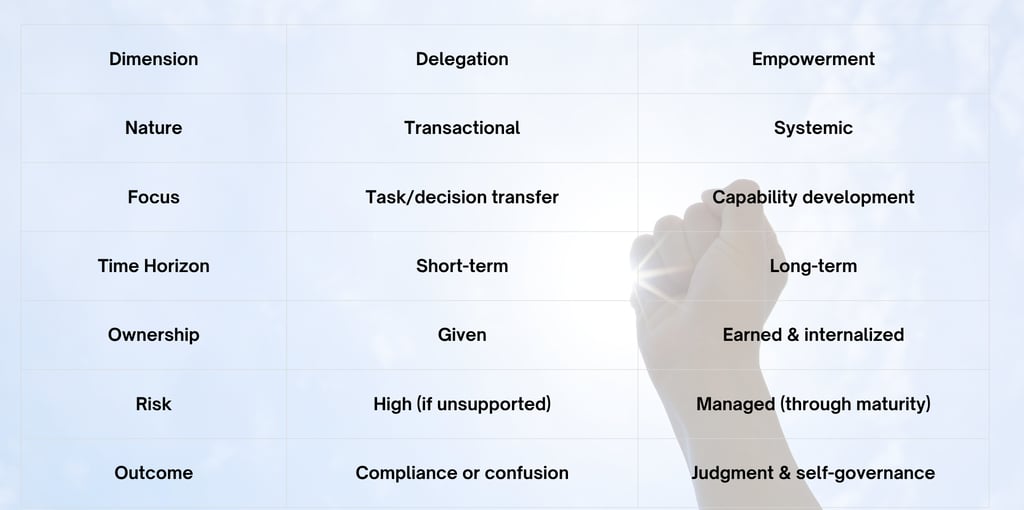
Because delegation is an act of transfer, while empowerment is a system of enablement.
And confusing the two is one of the most common reasons why “empowered teams” struggle with poor decisions, misalignment, analysis paralysis, or silent disengagement.
The Illusion of Empowerment
Let’s begin with a familiar pattern.
A leader says:
“I trust you—go ahead and decide.”
The intent is good. The tone is empowering.
But what often follows?
Decisions that don’t align with strategy
Over-indexing on local optimization
Fear-driven or risk-averse choices
Escalations disguised as autonomy
Burnout from invisible complexity
Why?
Because decision rights were delegated—but decision capability was not built.
Delegation vs. Empowerment: A Critical Distinction
Delegation answers:
“Who decides?”
Empowerment answers:
“How well can they decide in complex, ambiguous environments?”
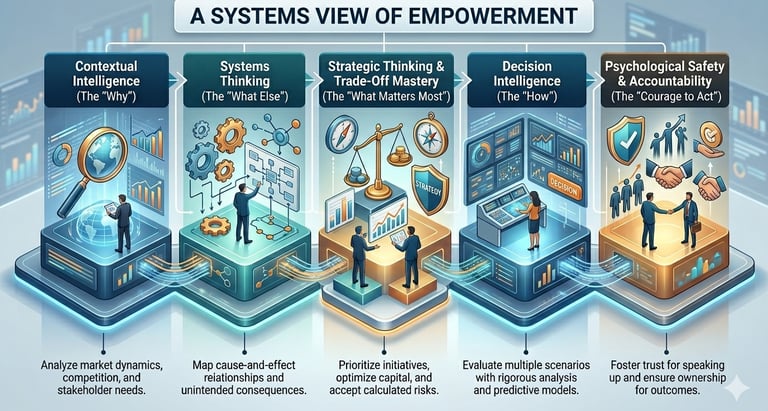
A Systems View of Empowerment
Empowerment is not an event. It is a multi-layered system that must be intentionally designed.
Think of it as an ecosystem with five interconnected capability layers:
1. Contextual Intelligence (The “Why”)
People cannot make good decisions without understanding the following:
Strategic intent
Organizational priorities
Value creation logic
Customer outcomes
Without context, autonomy becomes guesswork.
Toolkits:
Strategy-on-a-page (e.g., V2MOM, OKRs)
Value stream mapping
Customer journey immersion
North Star metrics alignment
2. Systems Thinking (The “What Else”)
Every decision has ripple effects.
Empowered individuals must see beyond silos:
Interdependencies
Second-order consequences
Feedback loops
Trade-offs across functions
Without systems thinking, decisions optimize parts—but damage the whole.
Frameworks:
Causal loop diagrams
Iceberg model (events → patterns → structures → mental models)
System maps across value chains
3. Strategic Thinking & Trade-Off Mastery (The “What Matters Most”)
Empowerment requires the ability to:
Navigate competing priorities
Make trade-offs under constraints
Balance short-term vs long-term
Align local decisions with enterprise goals
Without this, autonomy leads to fragmentation.
Techniques:
Eisenhower Matrix (urgency vs importance)
Cost of delay analysis
Scenario planning
Opportunity cost framing
4. Decision Intelligence (The “How”)
Decision-making is a discipline—not an instinct.
Empowered individuals need:
Structured decision frameworks
Bias awareness
Data interpretation skills
Clarity on when to decide vs escalate
Without decision intelligence, autonomy becomes inconsistency.
Frameworks:
RAPID (Recommend, Agree, Perform, Input, Decide)
OODA Loop (Observe, Orient, Decide, Act)
Cynefin Framework (simple, complicated, complex, chaotic)
Pre-mortem analysis
5. Psychological Safety & Accountability (The “Courage to Act”)
Even capable individuals hesitate if
Failure is punished
Leaders override decisions unpredictably
Accountability is unclear
Empowerment requires:
Safe-to-fail environments
Clear ownership boundaries
Constructive feedback loops
Without safety, autonomy becomes fear-driven compliance.
Why Delegation Alone Fails
Delegation without capability creates four systemic risks:
1. Decision Anxiety
People hesitate, delay, or escalate decisions due to lack of confidence.
2. Shadow Hierarchies
Decisions are “delegated” but still informally controlled by leaders.
3. Inconsistent Outcomes
Different individuals apply different logic, leading to variability.
4. Learned Helplessness
After a few failed attempts, people stop exercising autonomy altogether.
From Delegation to Self-Governance
True empowerment is not about distributing decisions—it is about building self-governing systems.
A self-governing individual or team:
Understands intent without constant direction
Makes aligned decisions under ambiguity
Balances autonomy with accountability
Continuously learns and adapts
This is where enterprise agility is truly realized.
Practical Framework: The Empowerment Stack
To operationalize empowerment, leaders must build across five layers:
Layer 1: Clarity
Define decision boundaries
Articulate strategy and priorities
Provide success metrics
Tool: Decision charters
Layer 2: Capability
Train in systems thinking, strategy, and decision-making frameworks.
Build analytical and critical thinking skills
Tool: Scenario-based simulations
Layer 3: Context
Share business insights transparently
Expose teams to cross-functional realities
Tool: Business storytelling sessions
Layer 4: Coaching
Shift from directing to guiding
Ask better questions instead of giving answers
Tool: GROW model (Goal, Reality, Options, Will)
Layer 5: Culture
Normalize experimentation
Reward judgment, not just outcomes
Learn from decisions, not just results
Tool: After-action reviews
The Leadership Shift Required
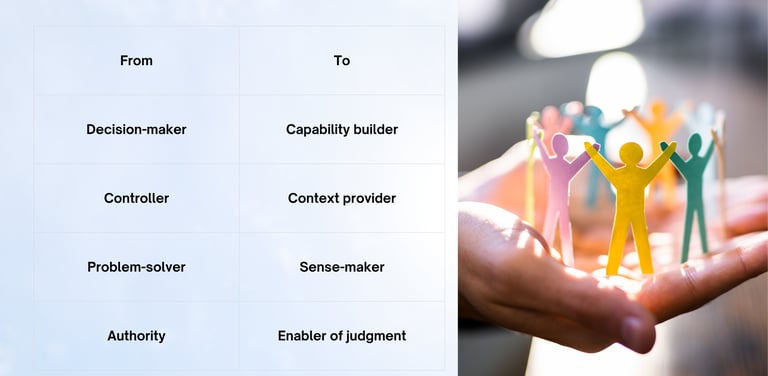
Empowerment demands a fundamental shift in leadership identity:
Leaders must ask themselves:
Have I given them context—or just control?
Have I built capability—or just assigned responsibility?
Have I enabled judgment—or just transferred risk?
A Final Reflection
Delegation is easy.
Empowerment is hard.
Delegation is a moment.
Empowerment is a system.
Delegation says:
“You decide.”
Empowerment ensures:
“You can decide well.”
And in a world of increasing complexity, ambiguity, and interdependence—
organizations don’t need more delegated decisions.
They need better decision-makers.
Provocation for Leaders
Before you say “I empower my team,” ask:
Are they equipped to handle competing priorities?
Can they see systemic consequences?
Do they understand strategic intent deeply?
Can they make tough trade-offs without guidance?
Do they possess decision intelligence—or just authority?
If not, what you have is not empowerment.
It’s delegation disguised as leadership maturity.