Monthly webinars starting soon .......

The Great AI Divide: Why Only 5% of Organizations Are Winning
Why are only a small fraction of organizations unlocking real value from AI despite massive investments? This thought leadership blog explores the growing gap between AI adoption and business impact, revealing why success depends on redesigning workflows, decision-making, and operating models—not just implementing technology. Drawing on insights from McKinsey, BCG, and leading AI reports, it outlines what defines an AI-first enterprise and how organizations can build adaptive, high-performing, future-ready systems in the age of AI.
AI FIRST MINDSET
Nivarti Jayaram
3/24/20263 min read
“AI is everywhere. Value is not.”
The Meeting That Felt… Off
A senior leader recently told me:
“We’ve deployed AI across the organization… but honestly, it hasn’t changed how we work.”
No one challenged it.
Because everyone in the room felt the same thing—but couldn’t quite articulate it.
The Illusion We’re Living In
We are in the middle of the biggest technology wave of our lifetime.
AI is in boardroom agendas
Generative AI is in workflows
Investments are at an all-time high
And yet…
Only a small fraction of organizations are capturing real value from AI
Roughly 5% are seeing meaningful financial impact
Let that land.
The Uncomfortable Truth
AI is not failing. Organizations are.
Not because they lack ambition.
Not because they lack tools.
But because they haven’t changed how work actually works.
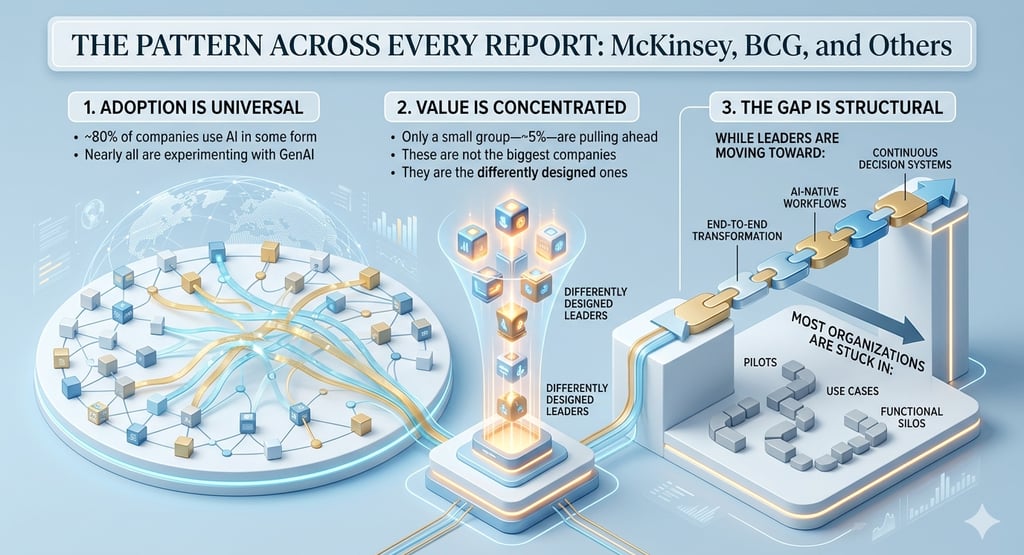
The Pattern Across Every Report
When you step back and connect insights from McKinsey, BCG, and others, a pattern emerges:
Adoption is Universal
~80% of companies use AI in some form
Nearly all are experimenting with GenAI
Value is Concentrated
Only a small group—~5%—are pulling ahead
These are not the biggest companies
They are the differently designed ones
The Gap is Structural
Most organizations are stuck in:
Pilots
Use cases
Functional silos
While leaders are moving toward:
End-to-end transformation
AI-native workflows
Continuous decision systems
The Moment It Becomes Real
This is where Brené Brown would pause and ask:
“What are we avoiding?”
Because deep down, leaders know:
If AI isn’t creating value… something else has to change.
The Hard Truth No One Wants to Say Out Loud
70% of AI value has nothing to do with AI.
It comes from:
Redesigning workflows
Rewiring decision-making
Rethinking roles and accountability
The Real Problem: We’re Optimizing the Past
Most organizations are doing this:
Adding AI to old systems
Layering tech on broken processes
It looks like progress.
But it’s not transformation.
The Shift: From AI Adoption → AI-First Enterprise
Let’s make this tangible.
AI-Enabled Organization
AI used in pockets
Decisions still hierarchical
Workflows still fragmented
Humans do the thinking, AI assists
AI-First Enterprise
AI embedded into workflows
Decisions happen in real-time
Work is dynamically orchestrated
Humans focus on judgement, trade-offs, accountability
The Three Transformations That Matter Most
Across all leading organizations, three shifts define success:
From Use Cases → Systems
AI is no longer about isolated applications.
It becomes a connected system across the enterprise.
From Projects → Continuous Loops
Work shifts from:
Linear processes
to
Continuous sensing, learning, adapting
From Automation → Human Value Creation
AI handles:
Speed
Scale
Execution
Humans focus on:
Judgement
Creativity
Accountability
The Rise of Agentic Organizations
We are entering a new phase:
AI is no longer just assisting
It is acting
Recommending decisions
Executing workflows
Optimizing systems
And this creates a new leadership question:
How much control are you willing to let go of?
The Leadership Identity Crisis
Adam Grant would call this a rethinking moment.
Brené Brown would call it a courage moment.
Because the role of a leader is fundamentally changing.
From:
Decision-maker
Controller
Planner
To:
System designer
Capability builder
Orchestrator
And here’s the hard part:
You have to let go of what made you successful.
The Organizations That Are Pulling Ahead
They are not doing more AI.
They are doing different work design.
They:
Redesign workflows end-to-end
Embed AI into decision systems
Build capability-based organizations
Continuously reallocate resources
Treat trust as a strategic asset
The Future Organization
Let’s paint the picture.
It is:
Continuous → Always sensing & adapting
Human + AI integrated → Augmented decision-making
Capability-based → Skills over roles
Fast → Real-time decisions
Trust-driven → Psychological safety
The future belongs to organizations that can adapt—continuously.
The Divide That Will Define the Next Decade
It won’t be:
Companies that use AI
vs
Companies that don’t
It will be:
Companies that redesign themselves
vs
Companies that don’t
The Question Leaders Must Answer
Before your next AI investment, pause.
Ask yourself:
Where are we adding AI… instead of redesigning work?
What decisions are still slow because of hierarchy?
Are we building systems—or just tools?
Reflection
What would we stop doing if we started fresh today?
What are we holding onto because it’s familiar?
Do we trust AI enough to act on it?
The future is not waiting for organizations to catch up.
It is already being built—by the few who understand this:
AI is not a technology advantage.
It is an organizational advantage.
And in the end…
The winners won’t be the most advanced.
They’ll be the most adaptable.