Monthly webinars starting soon .......

The Leadership Paradox: Why Executives Are Struggling More Than Ever
Why are leaders across all levels struggling despite increased investments in leadership development and transformation? This thought leadership blog explores the systemic challenges executives face—from frontline inefficiencies to strategic misalignment at the top—revealing why leadership issues are often rooted in organizational design, not individual capability. Backed by research from the Center for Creative Leadership, it highlights key gaps, integration challenges, and future-ready approaches to build resilient, high-performing enterprises.
LEADERSHIP AGILITYEXECUTIVE COACHING
Nivarti Jayaram
3/26/20264 min read
“We’ve never had more capable leaders… and yet leadership has never felt harder.”
The Quiet Confession in the C-Suite
In a closed-door executive session, a CEO said something rare:
“I don’t think the problem is our strategy.
I think the problem is how we’re trying to lead this organization.”
No one disagreed.
Because beneath every transformation initiative, every AI investment, every restructuring effort…
There is an unspoken reality:
Leadership itself is under strain.
The Evidence We Can’t Ignore
According to the Center for Creative Leadership’s research across 48,000 leaders and 7,000 organizations :
Leadership challenges are consistent across geographies and industries
But they manifest differently at each level of the organization
And they have intensified post-pandemic
The System Is Speaking—Are We Listening?
The research reveals something deeper than a list of challenges.
It reveals a pattern of misalignment across the enterprise system.
Let’s unpack it.
The Leadership System Breakdown
The Frontline Reality: Overwhelm and Friction
On page 2–3, frontline managers report:
Frustration with people and time
Weak operational processes
Challenges in team performance
What This Really Means
The system is inefficient.
Frontline leaders are not struggling because they lack capability.
They are struggling because:
Work is fragmented
Processes are unclear
Expectations are misaligned
The Middle Layer: The Pressure Sandwich
On page 4, mid-level leaders face:
Personal limitations (imposter syndrome)
Cross-functional influence challenges
Competing priorities
What This Really Means
The system is conflicted.
They are caught between:
Strategy and execution
People and performance
Authority and influence
The Senior Layer: The Credibility Gap
On page 5, senior leaders struggle with:
Credibility gaps
Market growth challenges
Process alignment across groups
What This Really Means
The system is disconnected.
Senior leaders are expected to:
Align across silos
Drive transformation
Influence without friction
But the system itself resists alignment.
The Executive Layer: The System Burden
On page 6, executives face:
Dynamic business environments
Strategic complexity
Organizational readiness gaps
Lack of cooperation
What This Really Means
The system is unstable.
Executives are not just leading organizations.
They are holding together systems that were never designed for today’s complexity.
The Deeper Insight: This Is Not a Leadership Problem
It’s tempting to say:
“We need better leaders.”
But that’s not what the data shows.
The Three Meta-Challenges Across All Levels
The research (page 7) clusters leadership challenges into three themes:
Personal growth challenges
Managing people and work
Managing across systems
The Hidden Truth
Leadership is breaking at the intersections.
Between self and system
Between people and performance
Between functions and enterprise
The Leadership Paradox
Here’s the paradox every executive is living:
We expect leaders to:
Be strategic
Be empathetic
Be decisive
Be collaborative
Be adaptive
In systems that are:
Fragmented
Hierarchical
Slow
Politically constrained
Misaligned
We are asking leaders to behave differently… without redesigning the system they operate in.
The Options Organizations Are Pursuing (And Their Limits)
Most enterprises are responding in predictable ways.
Let’s examine them.
Option 1: Leadership Development Programs
Coaching
Training
Capability building
Value:
Improves individual awareness
Builds interpersonal effectiveness
Gap:
Does not change systemic constraints
Option 2: Process Improvement Initiatives
Lean
Agile
Automation
Value:
Improves efficiency
Reduces friction
Gap:
Often localized—not enterprise-wide
Option 3: Structural Reorganization
New org charts
Role redesign
Centralization/decentralization
Value:
Creates clarity
Aligns accountability
Gap:
Often ignores informal networks and culture
Option 4: Technology & AI Adoption
Decision intelligence
Workflow automation
Data platforms
Value:
Enhances speed and insight
Gap:
Does not fix decision rights or trust
The Missing Link: Integration
Each of these options works.
But in isolation.
The real problem is not capability.
It is integration.
The Synergies That Must Be Built
To truly transform, organizations must connect:
1. Strategy ↔ Leadership
Strategy must translate into leadership behaviors
Leaders must embody strategic intent
2. Process ↔ People
Workflows must match how people collaborate
Not how org charts are designed
3. Technology ↔ Decision-Making
AI must be embedded into decisions
Not just dashboards
4. Structure ↔ Culture
Formal roles must align with informal influence networks
Transformation happens at the intersections—not within silos.
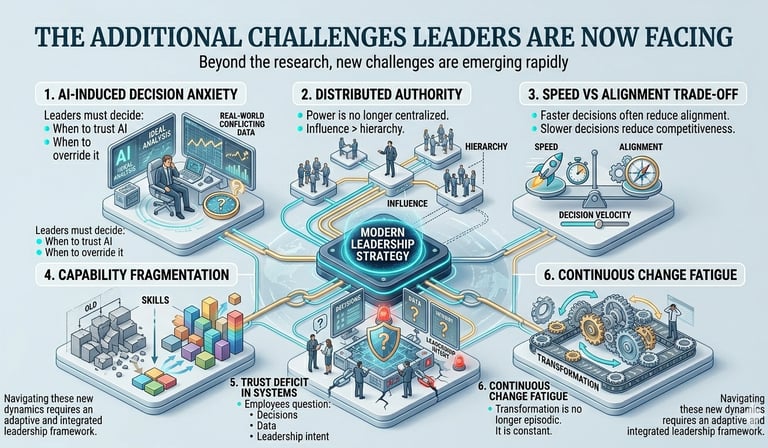
The Additional Challenges Leaders Are Now Facing
Beyond the research, new challenges are emerging rapidly:
1. AI-Induced Decision Anxiety
Leaders must decide:
When to trust AI
When to override it
2. Distributed Authority
Power is no longer centralized.
Influence > hierarchy.
3. Speed vs Alignment Trade-off
Faster decisions often reduce alignment.
Slower decisions reduce competitiveness.
4. Capability Fragmentation
Skills are evolving faster than roles can adapt.
5. Trust Deficit in Systems
Employees question:
Decisions
Data
Leadership intent
6. Continuous Change Fatigue
Transformation is no longer episodic.
It is constant.
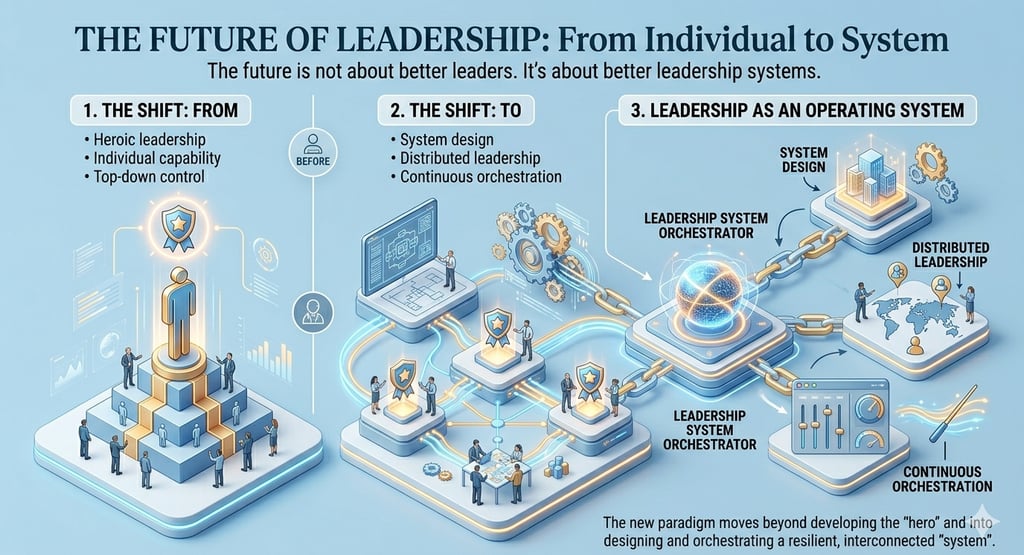
The Future of Leadership: From Individual to System
The future is not about better leaders.
It’s about better leadership systems.
The Shift
From:
Heroic leadership
Individual capability
Top-down control
To:
System design
Distributed leadership
Continuous orchestration
What Winning Organizations Will Do Differently
They will:
Redesign how work flows—not just roles
Align decision rights with accountability
Build capability-based systems
Embed trust & psychological safety into processes
Integrate AI into workflows—not layers
Viral Truths Worth Sharing
Leadership is not failing. The system is.
You cannot coach your way out of a broken operating model.
Most leadership challenges are system design failures in disguise.
The future of leadership is not about control—it’s about orchestration.
Questions for enterprises:
Where are leadership challenges actually system failures?
Which layer in your organization is under the most strain—and why?
Are your leaders solving problems… or compensating for them?
Reflection
What would your organization look like if leadership challenges disappeared?
What assumptions about leadership are no longer true?
Are you investing more in developing leaders—or redesigning the system?
The One Question That Matters
Are we building better leaders…
or a better system for leaders to succeed?
The organizations that will thrive are not the ones with:
The best leaders
But the ones with:
The best-designed leadership systems
Because in the end…
Leadership doesn’t fail in isolation.
It fails in systems that were never designed to support it.